CSpace / caps
Capability table entries. Rights are explicit slots, not ambient process privileges. SerialWrite isolation demo: A ok, B denied.
Project hub
AetherOS is a capability-first personal OS research project: privacy by construction (VeilNet grants), universal execution via host AetherIR (hand JIT + CLIF paths), Liminal microkernel isolation under QEMU, and a local twin shell that leaves only under an explicit grant - never telemetry-first, never ambient authority. Formal claims climb a public verification ladder (T0-T1 active).
This page is the living map of inception, architecture, and lab evidence. Green means QEMU serial and/or host lab observation - not an install CD and not a public source dump.
Why this project exists as its own category.
AetherOS is not a music generator, journal app, wellness tracker, or Linux rice. It is a local-first, privacy-sovereign multi-layer personal computing system - a microkernel plus fabric plus swarm - aimed at people who want authority to be explicit, execution to be hostable, and intelligence to stay on-device.
Design lineage is honest about its teachers: seL4-style capabilities, Zircon-like bulk memory rights, Genode-like recursive worlds, Barrelfish-like explicit messaging later - always remixed into Liminal's own object model rather than a fork.
Private monorepo (offline git + survival mirrors). This site is the shareable surface for architecture and progress - the source remains proprietary R&D.
Manifesto constraints as an index into architecture, lab gates, and cliffs. Not a proof certificate and not marketing.
| Principle | Layers | Mechanism | Gate / cliff | Map |
|---|---|---|---|---|
| P1 Privacy is ontological | L0 L3 L6 | EgressGrant; cover bound; zero net at birth | D3 D4 / N4 M1 | Grants | Lab | Adversary |
| P2 Universal execution | L2 | AetherIR + triple path into capability host | D2 / N1 M5 | Runtime |
| P3 Formal foundations | cross | Ladder T0-T1 active; T2-T5 calibrated climb | D* -> T0-T1 / N3 M2 | Verify |
| P4 Generative continuity | L4 L1 | Local UI/twin; no ambient phone-home | stub / M3 M4 | Arch L4 |
| P5 Hardware disposable | L5 L6 | Devices as projection; swarm continuity | deferred / N2 M6 | Cliffs |
| P6 Temporal sovereignty | L6 | Fork/discard/merge + grant world hygiene | D5 / M6 | Grants |
| P7 Cognitive sovereignty | L6 L1 | Twin egress only under explicit grant | D5 / M3 M6 | Grants |
Seven layers. Layer 0 is the root of authority; upper layers never invent ambient rights. Expand a layer for depth. Scan the authority flow first.
Collapsed layer lines state what is proven. Expanded depth may describe architectural plan. Green tags never mean full plan complete.
| Do not read as now | Allowed now | Plan / cliff |
|---|---|---|
| Full ELF/PE/Mach-O product loaders | IR + JIT + CLIF host demos (D2) | N1 cranelift-jit; M5 personalities |
| Personal mix ring as finished product | Phase0 grants + multi-hop host lab | Full mix; kernel NIC (M1) |
| Living UI weaver as shipping UI | Stub / minifb compositor | M4 compositor beyond stub |
| Twin co-pilot product | Twin shell surface + grant egress | Cognitive companion depth |
| Formally verified kernel | Verification ladder T0-T1 Active | T2-T5 climb (scaffold / planned) |
Human is root of trust. L0 holds pure capability authority. L3 may only birth packets under EgressGrant. L6 twin and timeline paths do not invent ambient egress; they reuse grant hygiene. L1/L4/L5 never mint network rights on their own.

Human root of trust
  -> L0 Liminal microkernel (Live under QEMU)
       -> L1 agents (Design + stubs): only via held caps
       -> L2 runtime fabric (IR + JIT host): capability host rights only
       -> L3 VeilNet (Phase0 + multi-hop lab): EgressGrant packet birth only
       -> L6 swarm + timeline (host paths): twin egress only under explicit grant
L4 compositor (stub) presents; does not invent rights
L5 hardware synthesis (deferred): no rights invented yet
L6 --grant hygiene--> L3
L3 --no grant--> quiet (no packet)
Liminal does not grant ambient network or file rights at birth. Authority is carried in capability objects. Design lineage includes seL4-style caps, remixed into Liminal's own model - not an seL4 Isabelle import.
Capability table entries. Rights are explicit slots, not ambient process privileges. SerialWrite isolation demo: A ok, B denied.
Physical memory rights mapped into a VSpace. No ambient mapping of foreign frames without a held cap.
Per-task address space with private CR3. Ring-3 enter via iretq; isolation proven under QEMU serial.
Explicit IPC path. Messaging is capability-gated, not ambient sockets.
Scheduling authority for preemptive RR and timer IRQ frame steal across dual VSpaces (lab green).
Construction rule: a fresh domain starts with zero network and zero ambient file authority. Upper layers may not invent those rights.
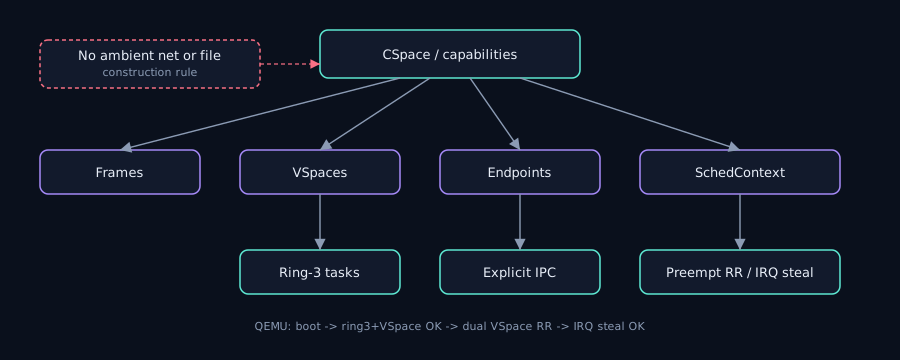
CSpace/caps -> Frame
CSpace/caps -> VSpace -> Ring-3 tasks
CSpace/caps -> Endpoint -> Explicit IPC
CSpace/caps -> SchedContext -> Preempt RR / IRQ steal
No ambient net or file rights -.-> CSpace
QEMU: boot -> ring3+VSpace OK -> dual VSpace RR -> IRQ steal OK
How a foreign binary is intended to enter AetherOS: lift into AetherIR, then execute only under capability-host rights. This is not Wine-as-architecture and not a claim that every loader format is product-complete.
Universal execution (P2) means foreign code becomes a guest of the capability host via AetherIR. Proven today on the host fabric: hand JIT + CLIF interpret + CLIF native emit, plus optional real Cranelift JIT behind feature cranelift-jit (quad parity on pure arith demos). Full ELF/PE/Mach-O product loaders and multi-personality HostSys remain calibrated cliffs.
Architectural intent: ELF/PE/Mach-O intake. Not every format is a finished product loader on the public map.
Intermediate representation for host execution paths. Lift/decode feeds the IR; rights stay outside the IR itself.
Hand JIT, CLIF interpret, and CLIF native emit with parity demos under D2 on the host lab.
Execution only with held caps. No ambient net or file rights are invented by the runtime fabric.

Foreign binary (plan: ELF/PE/Mach-O)
  -> Lift / decode -> AetherIR
       -> Hand JIT (D2 green)
       -> CLIF interpret (D2 green)
       -> CLIF native emit (D2 green)
  -> Capability host rights only (no ambient net/file)
  -.-> Personalities / HostSys (M5 mid cliff)
  -.-> cranelift-jit feature (N1 lab green, optional deps)
Not Wine-as-architecture. Host lab != guest kernel universal exec claim.
| Item | Status | Proof surface | Note |
|---|---|---|---|
| Hand JIT | Active (host) | D2 host demos / tests | Part of triple parity |
| CLIF interpret | Active (host) | D2 host demos / tests | Oracle / parity path |
| CLIF native emit | Active (host) | D2 host demos / tests | native_loop demos |
| Full multi-format loaders | Design / partial | Architectural intent | Not product-complete on map |
| Personalities / HostSys depth | Mid cliff M5 | Host design surface | Grant-only HostSys demos later |
| cranelift-jit crate | Lab green (feature) | Optional feature on | Real Cranelift JIT; default build stays light |
| Principle | Mechanism | Gate / cliff |
|---|---|---|
| P2 Universal execution | AetherIR + triple path into capability host | D2 / N1 / M5 |
| P1 Privacy ontological | Hosted code gets no ambient net; egress still needs grants | D3 + L3 |
| P3 Formal foundations | D2 is host behavioral + tests (T0), not translation proofs | #verify |
Collapsed row: id, title, status. Expand for purpose, evidence, non-goals. Status tags stay calibrated.
Pure capability authority (seL4 lineage), frames/VSpaces, endpoints, SchedContext. No ambient network or file rights.
Evidence: freestanding boot, cap table isolation, private VSpace CR3, ring-3, Yield-RR, IRQ steal, virtio rng/console/blk under QEMU. Object model above. Related gate: D1.
Sandboxed local AI operators: binary archaeologist, API cartographer, security guardian, cognitive companion, UI weaver, driver synthesizer.
Non-goal today: shipping autonomous product agents. Agents act only through held L0 caps; no ambient network from any agent role.
Proven on host (D2): hand JIT + CLIF interpret + CLIF native emit (triple parity demos). Foreign binaries are intended to enter a capability host, not Wine-as-architecture.
Plan (not all green): ELF/PE/Mach-O loaders, NBTE AOT/JIT cache, multi-personality HostSys (M5). N1 real Cranelift is optional feature lab green. IR + JIT host is the live tag.
Proven on host (D3/D4): EgressGrant packet birth, multi-hop path grants, cover bound to live grants. Construction property: no external packet without a live grant.
Plan (not all green): personal mix ring, cover morph, full mix profiles, kernel NIC TX. Tag remains Phase0 + multi-hop lab. See Grant continuity.
Proven today: stub compositor / minifb shell only. Generative spatial compositor is design language, not a shipping product surface.
Plan (not green): living UI weaver, multi-modal input (touch, voice, gesture). BCI remains deferred. Tag stays Stub compositor.
On-demand driver synthesis under formal constraints; device fingerprint; verified Linux driver shim path (later).
No rights invented while deferred. When active, drivers must still enter through capability constraints.
Owned-device mesh, encrypted digital twin, timeline fork engine for experiment and rollback. Hardware is disposable; the man is root of trust.
Host timeline fork/discard/merge green (D5). Twin egress only under explicit grant (P7). Cross-device durability is a mid cliff, not claimed finished.
Honest status as of the last kernel + host wave. Green means observed under test or QEMU serial, not marketing.
UEFI boot, caps, ring-3, private VSpace CR3, timer, preemptive RR, IRQ steal.
Hand JIT + CLIF interpret + CLIF→native x86 emit (triple parity on demos).
Deny-by-default packet birth, cover bound to live grants, idle = quiet.
Triangle AEAD + multi-hop + WAN TCP multi-hop lab with cover on the wire.
Fork / discard / merge continuity for experimental grant worlds.
How packets are born, how cover dies with grants, and how timeline forks keep experimental egress from leaking into the parent world.
VeilNet is not a default-deny firewall bolted on later. It is a construction property: a fresh domain has zero network authority. External packets exist only while a live grant says they may. Cover traffic is charged to that grant and ceases when the grant dies. Timeline forks carry experimental grant worlds; discard revokes them; merge never auto-imports net grants without an explicit human gate.
Capability object that authorizes packet birth for a subject domain. Scope, rights, budget, and cover binding are part of the object, not ambient policy files.
Multi-hop authorization along an owned-device or lab path. Intermediate hops do not invent ambient clearnet rights. Observed on host multi-hop WAN TCP lab paths.
Grant-bound cover schedule. While the grant is live, cover may run; when the grant is revoked or expires, cover stops. Idle domains stay quiet by construction.
A timeline fork's tagged grant set used for experiment. Discard tears the world down. Merge into parent requires hygiene so residual egress cannot sneak through.
Cover is not ambient presence. It is a budgeted schedule charged to a live grant. While the grant lives, payload and/or cover cells may leave the domain. When the grant dies, cover ceases by construction so idle domains go quiet. That is a local construction property on host fabric paths, not a free win against a global passive adversary.

Fresh domain (zero net)
  -> No live grant -> wire: no domain-originated cells
  -> mint EgressGrant -> Grant live
  -> Cover charged to grant lifetime
  -> Payload and/or cover cells may leave
  -> REVOKE or expiry -> cover stops -> Idle quiet
Lab OPEN/TICK/REVOKE exercises this; not a consumer API.
Observer class: local underlay / link observer (A-ISP class). Explicitly not end-to-end global passive adversary (A-GPA) confirmation.
| Domain state | What may leave | What observer may notice | What stops / residual |
|---|---|---|---|
| No grant | Nothing (no ambient TX, no cover beacons) | Silence on that fabric path | Other host/OS noise outside VeilNet may still exist |
| Live grant + cover | Payload and/or grant-bound cover cells | Presence of traffic; volume/timing shape of schedule | Raises idle fingerprint cost; does not erase timing classes |
| REVOKE / expiry | No new birth; cover scheduler stops | Traffic for that grant ends toward quiet | History already observed; other live grants may still emit |
Interactive browser model of OPEN / TICK / REVOKE and timeline FORK / DISCARD / MERGE. Demonstrates the construction property: no external packet without a live grant; cover dies with the grant.
Fabric path (cells vs silence)
A-ISP class: silence on this fabric path (no ambient TX)
Try: OPEN then TICK several times, then REVOKE and watch silence. Or FORK, OPEN on the experimental world, DISCARD (or MERGE with HumanGate). TICK with NoGrant is always DENIED.
Lab control plane words OPEN / TICK / REVOKE (plus PING / HOST / SHUTDOWN on standing services) describe host fabric cover-daemon exercises. Not a public consumer API and not a production multi-host product.
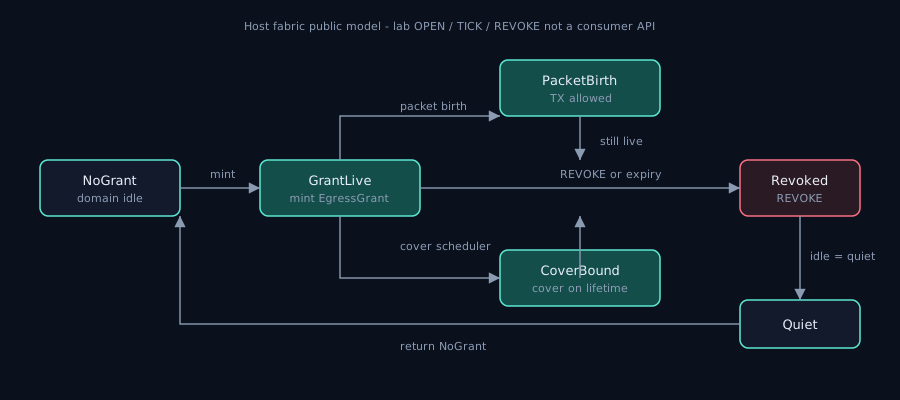
NoGrant --mint--> GrantLive --packet birth / cover--> GrantLive
GrantLive --REVOKE or expiry--> Revoked --> Quiet (idle = quiet)
NoGrant: no ambient egress path exists
Demo gate D5 is green on host timeline engine paths: fork, discard, and merge of experimental continuity. This is not a claim of full kernel COW snapshots or cross-device timeline migration. Those remain later phases.

Main --fork--> Exp --mint scoped grants--> LabWorld
LabWorld --discard--> Sink (grants dead, no residual egress)
LabWorld --merge + HumanGate--> Main (no auto net grants)
Twin egress only under explicit grant
| Principle | Object / mechanism | Demo gate |
|---|---|---|
| P1 Privacy is ontological | EgressGrant packet birth; cover bound to lifetime; idle quiet | D3 |
| P6 Temporal sovereignty | Fork experimental grant worlds; discard revokes; merge with hygiene | D5 |
| P7 Cognitive sovereignty | Encrypted twin leaves the swarm only under an explicit grant | D5 / L6 |
AetherOS does not claim seL4-complete proofs. The ladder is tracked in public language here so expectations stay calibrated. Security climbs; it is not asserted in marketing.
Demo gates D1-D5 green means lab observation under QEMU serial and host tests. That is not the same as model-checked or proof-discharged security. Tier 0-1 are the live floor today. Higher tiers are scaffold, planned, or design-compatible only.
Runs in the lab now: rustc, cargo test, and authored cap property tests.
Shapes, hooks, or design docs exist. Not a green proof CI suite and not discharged proof functions.
Direction of climb only. Full Verus / Lean proofs are not claimed.
Lineage may be compatible with an seL4-style substrate. Not an Isabelle-complete import and not a forked verified kernel.

T0 rustc + cargo test ACTIVE
T1 Cap property tests ACTIVE
T2 Kani SCAFFOLD
T3 Verus-style hooks SCAFFOLD
T4 Verus / Lean full proofs PLANNED (not claimed)
T5 seL4 substrate option DESIGN-COMPATIBLE ONLY
D1-D5 lab evidence feeds T0-T1 only
Each green gate has a primary evidence class. Empty formal cells are intentional: gates do not invent Tier 4 proofs.
| Gate | Lab claim | Evidence class | Ladder touch |
|---|---|---|---|
| D1 | Kernel isolation under QEMU | Runtime observation (serial markers) | T0 (+ tests where present) |
| D2 | Hand JIT + CLIF interpret + native emit | Host behavioral demo + unit tests | T0 |
| D3 | Deny-by-default packet birth; cover bound | Host lab / property intent | T0-T1 |
| D4 | Triangle AEAD + multi-hop WAN TCP lab | Host lab demo (not crypto formal proof) | T0 |
| D5 | Fork / discard / merge host paths | Host behavioral demo | T0 |
| Tier | Tool | Status |
|---|---|---|
| 0 | rustc + cargo test | Active |
| 1 | Cap property tests | Active |
| 2 | Kani model checking | Scaffold |
| 3 | Verus-style hooks | Scaffold |
| 4 | Verus / Lean full proofs | Planned |
| 5 | seL4 substrate option | Design-compatible only |
Buys: typecheck and unit tests on paths that run in lab.
Does not buy: kernel isolation theorems or machine-checked refines-to-binary proofs.
Buys: authored property / invariant tests where present.
Does not buy: model-checked or proof-discharged caps.
Buys: harness intent and cfg-shaped hooks.
Does not buy: a claimed green Kani CI suite.
Buys: Verus-shaped hooks and a design invariant document.
Does not buy: real proof fn discharge on a Verus toolchain.
Buys: direction of climb only.
Does not buy: any complete kernel proof today.
Buys: capability lineage compatible with seL4-style authority as a design option.
Does not buy: seL4 Isabelle completeness or a verified seL4 fork shipping as AetherOS.
Shipped slices you can exercise on the lab host today.
Liminal freestanding boot OK
ring3+VSpace isolation OK
virtio-rng modern entropy OK
virtio-console multiport CTRL+TX OK
virtio-blk modern WRITE+READ OK
virtio-blk modern MULTI+FLUSH OK
ring3 IRQ steal OK
boot OKTrue remaining cliffs after the modern MULTI+FLUSH / CLIF / multi-hop / Verus-hooks wave. Near is ship order. Mid is real architecture surface still under-sold by a flat four-item list. Never is deferred by design.
Visual estimate of the road ahead. Lab boot under QEMU is already green. Bars are ambition bands, not promised ship dates. Focus and funding shift the calendar.
QEMU/UEFI freestanding boot, D1-D5 green, virtio + host fabric labs. Already shipping evidence on this map.
Done under QEMUShell residency + mini FS lab green (D6-D7). Next: load userspace ELF (D8), net app path (D9). Feels like a tiny OS in QEMU.
D6-D7 lab greenGuest VeilNet TX path, Verus climb, agent swarm crates, compositor beyond stub, personality/FS depth, richer net and timeline durability.
Mid cliffsToward a machine you could live in: durable swarm, stronger formal story, UI/twin continuity. Bare metal and daily-driver polish only with explicit ask. Not a Windows replacement promise.
Ambition bandSupport independent R&D if this map is useful to you. Cash App: $JonBaileyxyz.
Optional cranelift-jit feature wires real Cranelift (0.120). Quad parity lab green on pure arith demos. Default build stays light without the feature. Remaining: broader ops and product loaders.
Standing process-per-host cover service lab is green (shared grant across reconnect; two-host localhost). Remaining: production durability, supervision, routable WAN beyond lab. Not a consumer product.
Invariants documented; hooks scaffold. Next is real proof fn discharge on a Verus toolchain.
Virtio-net modern first path is lab green under QEMU (DRIVER_OK + TX + RX via DHCP Discover / SLIRP Offer). Remaining: multiport port1 data queues, IRQ-driven RX, multi-buffer. Not a guest Fabric TX stack.
These are real remaining surfaces already admitted by layer tags and lab boundaries. They are not secret green work and not claimed finished.
Host Phase0 + multi-hop labs are green. Grant-bound egress inside the guest kernel / NIC path is not claimed.
Kani-shaped harness intent exists as scaffold. Runnable green Kani CI is not claimed.
Design + early host stubs only. Not a shipping local AI operator product.
minifb / stub compositor only. Living UI weaver is not a shipped product surface.
IR + JIT live on host. Full multi-personality and HostSys FS grant demos remain deeper cliffs.
Host fork / discard / merge paths are green. Cross-device timeline migrate is later phase, not claimed.
Full Cocoa/Win32 as core UI | seL4-complete Isabelle | neuromorphic / BCI | bare metal without an explicit ask.
A ground-up capability-first personal OS research project: Liminal microkernel, VeilNet, AetherIR fabric, personal swarm and timeline continuity.
No. Proprietary private R&D. This hub tracks vision and status; it is not a public source tree.
No. Freestanding Rust no_std kernel plus host crates - not a distro or kernel fork.
Deny-by-default network fabric. Packets require a live EgressGrant; cover is grant-bound so idle stays silent.
Seven layers: capability microkernel through personal swarm and temporal continuity. Upper layers never invent ambient authority.
Lab builds target QEMU/UEFI on a development host with Rust + QEMU. There is no public consumer installer yet.
Only under a live EgressGrant (or composed path grant). A domain with no grant has no ambient egress path. See Grant continuity.
Cover is bound to grant lifetime. On REVOKE or expiry, cover ceases. Idle domains stay quiet by construction on host fabric lab paths (D3). See Cover construction and adversary ledger.
Discard drops the experimental branch and must revoke experimental egress so no residual packet birth remains. Merge does not auto-import net grants without an explicit human gate (D5 host engine paths).
No. Cognitive sovereignty: the encrypted twin leaves the personal swarm only under an explicit grant. There is no ambient twin egress channel.
QEMU serial markers and cargo / cap property tests (Tier 0-1 Active). Demo gates D1-D5 are lab-green, not machine-checked full proofs.
No. Scaffold means hooks, shapes, or design docs exist. It is not running proof CI and not discharged Verus or Kani suites.
No. seL4-style capabilities are design lineage. Tier 5 is design-compatible only. Isabelle-complete seL4 is explicitly deferred.
No public source tree. The monorepo is proprietary R&D. This hub publishes calibrated status, not proof artifacts.
No. Foreign binaries are intended to enter a capability host via AetherIR, not reimplement a foreign OS as architecture. See Runtime Fabric Codex.
Host lab D2: hand JIT + CLIF interpret + CLIF native emit with parity demos. Full multi-format loaders and multi-personality HostSys are not claimed complete.
Not as a default dependency. Optional feature cranelift-jit wires real Cranelift with lab parity tests. Hand JIT + CLIF paths remain the default light stack.
No free GPA defeat on public low-latency edges. Cover is grant-bound construction on host fabric paths: idle quiet when grants die. See the adversary observation ledger.